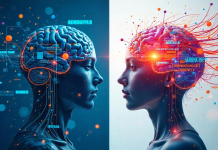
Machine Learning (ML) is a powerful subset of artificial intelligence (AI) that enables computers to learn and improve from experience without explicit programming. It involves the development of algorithms and statistical models that allow systems to identify patterns and make predictions or decisions based on data. ML algorithms can be categorized into supervised learning, unsupervised learning, and reinforcement learning, each serving specific purposes.
In supervised learning, models are trained on labeled data, where the algorithm learns to map input to output by recognizing patterns. Unsupervised learning involves extracting meaningful insights from unlabeled data, discovering hidden patterns or structures. Reinforcement learning focuses on training models to make sequential decisions through trial and error, receiving feedback in the form of rewards or penalties.
Machine Learning applications span various domains, including image and speech recognition, natural language processing, recommendation systems, and autonomous vehicles. As the field continues to advance, ML plays a crucial role in transforming industries and shaping the future of technology.
What is Machine Learning?
Machine Learning is a branch of artificial intelligence (AI) that empowers computers to learn and improve from experience without explicit programming. It involves the development of algorithms and models that enable systems to automatically analyze and interpret data, recognize patterns, and make decisions or predictions. The learning process is iterative, allowing the system to adapt and refine its performance over time as it encounters new data. Machine Learning encompasses various techniques, including supervised learning, unsupervised learning, and reinforcement learning. In supervised learning, the algorithm is trained on labeled data, while unsupervised learning involves extracting patterns from unlabeled data. Reinforcement learning focuses on training systems to make decisions by interacting with an environment and receiving feedback. Machine Learning applications are diverse, ranging from image and speech recognition to recommendation systems and autonomous vehicles.
History of Machine Learning :
The history of machine learning can be traced back to the mid-20th century, and it has evolved through several stages of development. Here is an overview of key milestones in the history of machine learning:
- 1940s-1950s: Early Foundations
- The roots of machine learning can be traced back to the work of Alan Turing, who proposed the concept of a universal machine capable of performing any computation. His ideas laid the foundation for the development of artificial intelligence (AI) and machine learning.
- 1956: Dartmouth Conference
- The term “artificial intelligence” was coined at the Dartmouth Conference in 1956. This event marked the beginning of AI research as a distinct field, and early efforts in machine learning were closely tied to AI.
- 1950s-1960s: Perceptrons and Rosenblatt’s Work
- Frank Rosenblatt introduced the perceptron, a simple algorithm for binary classification. While perceptrons had limitations, they were an early attempt at creating a learning algorithm inspired by the way the human brain works.
- 1960s-1970s: AI Winter
- The field of AI, including machine learning, faced skepticism and a decline in funding during the AI winter. Progress was slow, and expectations often exceeded the capabilities of the technology at the time.
- 1980s-1990s: Connectionism and Backpropagation
- The connectionist approach gained popularity, focusing on neural networks and parallel processing. The backpropagation algorithm, a method for training multi-layer neural networks, was developed during this period, contributing to the resurgence of interest in machine learning.
- 1997: IBM’s Deep Blue vs. Garry Kasparov
- IBM’s Deep Blue, a chess-playing computer, defeated world chess champion Garry Kasparov. While this event was not strictly machine learning, it showcased the potential of advanced algorithms in strategic decision-making.
- Late 1990s-2000s: Support Vector Machines and Boosting
- Support vector machines (SVMs) and boosting algorithms gained popularity as effective machine learning techniques. SVMs were particularly successful in solving classification problems.
- 2000s-2010s: Rise of Big Data and Deep Learning
- The availability of large datasets and increased computational power facilitated the application of machine learning on a larger scale. Deep learning, with its deep neural networks, became a dominant approach, achieving breakthroughs in image and speech recognition.
- 2012: ImageNet and Deep Learning Success
- The ImageNet Large Scale Visual Recognition Challenge saw a significant improvement in image classification accuracy, thanks to deep learning methods. This marked a turning point in the effectiveness of neural networks.
- 2010s-Present: Machine Learning in Industry
- Machine learning applications expanded into various industries, including healthcare, finance, marketing, and more. Algorithms like reinforcement learning gained attention for their success in training agents to perform complex tasks.
- 2020s: Continued Advancements
- Machine learning continues to evolve, with ongoing research in areas such as explainability, fairness, and robustness. Advances in natural language processing, reinforcement learning, and generative models contribute to the field’s growth.
The history of machine learning reflects a journey from early theoretical foundations to the current era of practical applications across diverse domains. Ongoing research and technological advancements ensure that machine learning will play a crucial role in shaping the future of AI.
Theory of Machine Learning :
Machine learning is a field of artificial intelligence (AI) that focuses on developing algorithms and models that enable computers to learn from data and make predictions or decisions without being explicitly programmed. The underlying theory of machine learning encompasses various concepts and principles. Here are some key aspects of the theory of machine learning:
- Types of Machine Learning:
- Supervised Learning: In supervised learning, the algorithm is trained on a labeled dataset, where the input data is paired with corresponding output labels. The goal is to learn a mapping function that can accurately predict the output for new, unseen inputs.
- Unsupervised Learning: Unsupervised learning involves finding patterns or structures in data without explicit output labels. Clustering and dimensionality reduction are common tasks in unsupervised learning.
- Reinforcement Learning: In reinforcement learning, an agent learns to make decisions by interacting with an environment. The agent receives feedback in the form of rewards or penalties, and its objective is to learn a policy that maximizes the cumulative reward over time.
- Model Training:
- Objective Function: During training, machine learning models aim to optimize an objective function, also known as a loss or cost function. This function quantifies the difference between the predicted outputs and the true labels.
- Optimization Algorithms: Optimization algorithms, such as gradient descent, are used to minimize the objective function and update the model’s parameters iteratively.
- Overfitting and Underfitting:
- Overfitting: Occurs when a model learns the training data too well, capturing noise and irrelevant patterns, but fails to generalize to new, unseen data.
- Underfitting: Occurs when a model is too simple and cannot capture the underlying patterns in the training data.
- Bias and Variance:
- Bias: The error introduced by approximating a real-world problem, which may be complex, by a simplified model. High bias can lead to underfitting.
- Variance: The model’s sensitivity to small fluctuations in the training data. High variance can lead to overfitting.
- Cross-Validation:
- Cross-validation is a technique used to assess a model’s performance by splitting the data into multiple subsets for training and evaluation. It helps in obtaining a more reliable estimate of a model’s generalization performance.
- Feature Engineering:
- Feature engineering involves selecting, transforming, or creating new features from the raw data to improve a model’s performance.
- Ensemble Learning:
- Ensemble methods combine predictions from multiple models to improve overall performance. Common techniques include bagging (e.g., Random Forests) and boosting (e.g., AdaBoost, Gradient Boosting).
- Deep Learning:
- Deep learning is a subset of machine learning that focuses on neural networks with multiple layers (deep neural networks). It has shown remarkable success in tasks such as image and speech recognition.
- Ethical Considerations:
- The theory of machine learning also involves ethical considerations, as models may inadvertently perpetuate biases present in the training data or raise issues related to privacy and security.
Understanding and applying these concepts is crucial for developing effective machine learning models and ensuring responsible and ethical use of AI technologies. The field continues to evolve, with ongoing research and advancements contributing to the theory and practice of machine learning.
Applications and Benefits of Machine Learning :
Machine learning (ML) is a powerful tool with diverse applications and numerous benefits across various fields. Some of the key applications and benefits include:
Applications:
- Healthcare: ML aids in disease identification, personalized treatment plans, drug discovery, and medical imaging analysis.
- Finance: Used for fraud detection, risk assessment, algorithmic trading, and customer service via chatbots.
- Retail: Helps in recommendation systems, demand forecasting, pricing optimization, and inventory management.
- Automotive: Enables self-driving cars, predictive maintenance, and traffic prediction for smart navigation.
- Natural Language Processing (NLP): Powers chatbots, language translation, sentiment analysis, and content summarization.
- Image and Video Analysis: Used in facial recognition, object detection, image classification, and video content analysis.
- Manufacturing: Facilitates predictive maintenance, quality control, supply chain optimization, and process automation.
- Environmental Sciences: Supports climate modeling, natural disaster prediction, and resource management.
Benefits:
- Automation: ML automates repetitive tasks, reducing human intervention and enhancing efficiency.
- Insights from Big Data: Helps in analyzing and extracting meaningful insights from large datasets.
- Personalization: Enables personalized recommendations and services based on user preferences.
- Improved Decision-Making: Provides data-driven insights for better and faster decision-making.
- Cost Reduction: Optimizes processes, reduces errors, and enhances productivity, leading to cost savings.
- Enhanced Accuracy: ML models can learn from data and improve accuracy over time.
- Innovation: Drives innovation by enabling the development of new products and services.
- Risk Mitigation: Assists in identifying and mitigating risks in various domains.
Machine learning continues to evolve, expanding its applications and benefits across industries. Its adaptability and capability to leverage data for actionable insights make it a crucial component of modern technological advancements.