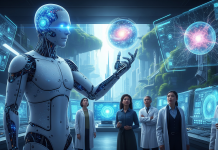
Artificial Intelligence (AI) has revolutionized everything from how we communicate to how we drive, shop, and work. But in recent years, a new form of AI has taken center stage: Generative AI. While both generative AI and traditional AI fall under the same umbrella, they serve different purposes, use different technologies, and solve problems in fundamentally different ways.
In this blog, we’ll explore the key differences between Generative AI and Traditional AI, supported by real-world examples and data to help you understand their unique roles in today’s AI-driven world.
What is Traditional AI?
Traditional AI refers to rule-based or pattern-recognition systems designed to perform specific tasks based on predefined logic or algorithms. It includes:
- Predictive models
- Recommendation systems
- Classification tasks
- Decision trees and expert systems
Example:
Fraud detection in banking — Traditional AI uses past transaction data to detect anomalies. If someone in India suddenly tries to withdraw $10,000 in New York, the system flags it as suspicious based on patterns and thresholds.
What is Generative AI?
Generative AI, on the other hand, goes beyond task execution. It can create new content, such as text, images, audio, video, and even code, by learning from massive datasets.
This branch of AI uses models like Generative Adversarial Networks (GANs), Transformer models (e.g., GPT, BERT), and Diffusion Models to generate new, often human-like outputs.
Example:
ChatGPT or Midjourney — You can ask ChatGPT to write a poem in Shakespearean style or use Midjourney to create digital art based on a text prompt. These outputs weren’t programmed explicitly; the AI generated them.
Key Differences at a Glance
| Feature | Traditional AI | Generative AI |
|---|---|---|
| Purpose | Analyzing data, making decisions | Creating new content |
| Output Type | Predictions, classifications | Text, images, videos, music, etc. |
| Data Usage | Uses labeled, structured data | Uses vast unstructured datasets |
| Model Examples | Decision trees, SVM, logistic regression | GPT-4, DALL·E, Stable Diffusion |
| Training Requirement | Less compute-intensive | Highly compute-intensive |
| Interactivity | Reactive | Interactive and dynamic |
| Examples | Spam filters, credit scoring | Text-to-image generators, chatbots |
Real-World Applications: Traditional AI vs Generative AI
Traditional AI Use Cases:
- Netflix Recommendations — Based on your history, it predicts what you might like.
- Self-driving cars — Uses sensors and algorithms to detect obstacles and make driving decisions.
- Speech Recognition — Converts spoken words into text (e.g., Siri, Google Assistant commands).
Generative AI Use Cases:
- Content Creation — Tools like ChatGPT or Jasper AI write blogs, emails, or code.
- Image Generation — DALL·E 3 or Midjourney can create artwork from a prompt like “a cat wearing a spacesuit on Mars.”
- Video and Music Synthesis — AI like Sora (by OpenAI) or Amper Music creates unique music and videos from scratch.
Data Insights
- According to McKinsey (2024), companies using generative AI in content creation saw 30-50% time savings in marketing workflows.
- A Statista 2023 report noted that 80% of global enterprises were already using traditional AI in fraud detection, while 34% had begun integrating generative AI tools.
- PwC (2023) estimated that Generative AI could add $15.7 trillion to the global economy by 2030, largely through automation and creative augmentation.
Limitations & Risks
Traditional AI:
- Limited to predefined functions
- Doesn’t handle unstructured data well
- Struggles with ambiguous or creative tasks
Generative AI:
- Risk of hallucinations (confident but wrong outputs)
- Can be misused for deepfakes, fake news, or misinformation
- High resource requirements for training and inference
Future Outlook
While traditional AI is excellent for deterministic tasks like fraud detection, logistics optimization, or loan approval, Generative AI opens up a future where machines don’t just analyze but imagine.
With ongoing advancements in multimodal AI (like GPT-4o), which blends text, image, and audio understanding, we are heading toward an era where AI can interact with the world more like humans do—across senses, formats, and intentions.
Conclusion
Traditional AI is the foundation — precise, reliable, and rule-based.
Generative AI is the frontier — creative, flexible, and disruptive.
Both play crucial roles in our evolving digital landscape, and understanding their differences helps businesses, creators, and technologists harness their power effectively.