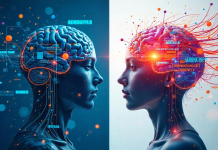
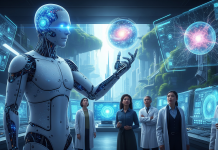
Artificial Intelligence (AI) is a cutting-edge field of computer science that aims to create intelligent machines capable of mimicking human cognitive functions. By leveraging algorithms and advanced computing power, AI systems can analyze vast amounts of data, learn from patterns, and make decisions or solve problems autonomously. Machine learning, a subset of AI, enables systems to improve their performance over time without explicit programming. Natural Language Processing (NLP) allows AI to understand and respond to human language, while computer vision enables machines to interpret and make sense of visual information. AI applications span diverse domains, from virtual assistants and autonomous vehicles to healthcare diagnostics and financial predictions. As AI continues to evolve, its impact on society, economy, and various industries is profound, reshaping the way we work, communicate, and interact with technology.
What is Artificial intelligence?
Artificial Intelligence (AI) refers to the development of computer systems that can perform tasks that typically require human intelligence. These tasks encompass a range of activities such as learning, reasoning, problem-solving, perception, and language understanding. AI systems leverage algorithms and data to mimic cognitive functions, enabling them to analyze patterns, make decisions, and adapt to changing circumstances. Machine learning, a subset of AI, involves training algorithms with data to improve their performance over time without explicit programming. AI applications span diverse domains, including speech recognition, image processing, natural language processing, and autonomous systems. As technology advances, AI continues to play a pivotal role in transforming industries, enhancing efficiency, and driving innovation across various sectors such as healthcare, finance, transportation, and more.
History of Artificial intelligence :
The history of artificial intelligence (AI) can be traced back to ancient times, but the formal development of the field as we know it today began in the mid-20th century. Here is a brief overview of the key milestones in the history of AI:
- Ancient History:
- The concept of creating artificial beings with human-like intelligence dates back to ancient mythology. Stories of automatons and golems can be found in various cultures.
- Automata and Mechanical Devices (17th-19th centuries):
- During the 17th century, inventors like Blaise Pascal and Gottfried Wilhelm Leibniz began creating mechanical calculators.
- In the 18th and 19th centuries, automata like Jacques de Vaucanson’s duck and Charles Babbage’s designs for the Analytical Engine laid the groundwork for future developments.
- Emergence of Formal AI (20th century):
- 1943-1956: Foundations of Computing. The work of Alan Turing, John von Neumann, and others laid the theoretical foundations of computing, including the idea of a universal machine capable of performing any computation.
- 1950: Turing Test. Alan Turing proposed the Turing Test as a measure of a machine’s ability to exhibit intelligent behavior indistinguishable from that of a human.
- 1951: Marvin Minsky and Dean Edmonds built the SNARC, the first neural network computer.
- The Dartmouth Conference (1956):
- John McCarthy, Marvin Minsky, Nathaniel Rochester, and Claude Shannon organized the Dartmouth Conference, marking the official birth of AI as a field of study. The conference attendees were optimistic about the future of artificial intelligence.
- Early AI Research (1950s-1960s):
- Researchers developed early AI programs, including the Logic Theorist by Allen Newell and Herbert A. Simon, and the General Problem Solver (GPS) by Newell and J.C. Shaw.
- The first AI program for playing chess, called the Logic Theorist, was developed in 1956.
- AI Winter (1970s-1980s):
- Funding and interest in AI waned due to overpromising and underdelivering. The challenges of developing AI systems that could perform tasks that seemed simple to humans were more significant than initially anticipated.
- Expert Systems (1980s):
- AI research shifted towards expert systems, which were rule-based systems designed to emulate the decision-making abilities of a human expert in a specific domain.
- Revival and Machine Learning (1990s-2000s):
- Advances in machine learning, especially neural networks, reignited interest in AI. The development of algorithms like backpropagation contributed to the effectiveness of neural networks.
- Big Data and Deep Learning (2010s-2020s):
- The availability of large datasets and powerful computing resources facilitated breakthroughs in deep learning. Deep neural networks, particularly convolutional neural networks (CNNs) and recurrent neural networks (RNNs), achieved remarkable results in image and speech recognition, natural language processing, and more.
- Recent Developments (2020s):
- AI continues to advance rapidly, with applications in diverse fields such as healthcare, finance, autonomous vehicles, and robotics. Ethical considerations, responsible AI, and AI policy discussions have also gained prominence.
The history of AI is marked by cycles of optimism, followed by periods of skepticism, but recent decades have seen unprecedented progress, making AI an integral part of modern technological advancements.
Types of Artificial intelligence :
Artificial Intelligence (AI) can be categorized into different types based on its capabilities, functions, and applications. Here are some common types of artificial intelligence:
- Narrow AI (Weak AI): This type of AI is designed and trained for a specific task or a narrow set of tasks. It operates within a limited context and doesn’t possess general intelligence. Most of the AI applications we encounter today, such as virtual personal assistants and image recognition software, fall under narrow AI.
- General AI (Strong AI): General AI refers to a form of artificial intelligence that has the ability to understand, learn, and apply knowledge across different domains, similar to human intelligence. Achieving true general AI is a complex and challenging goal that researchers are still working towards.
- Machine Learning (ML): Machine learning is a subset of AI that focuses on developing algorithms and statistical models that enable computers to perform tasks without explicit programming. It involves the use of data to train models and improve their performance over time.
- Supervised Learning: The algorithm is trained on a labeled dataset, where the input data is paired with corresponding output labels. The model learns to map inputs to outputs.
- Unsupervised Learning: The algorithm is given unlabeled data and must find patterns or relationships within the data without explicit guidance.
- Reinforcement Learning: The algorithm learns by interacting with its environment. It receives feedback in the form of rewards or penalties and adjusts its actions to maximize cumulative rewards.
- Deep Learning: Deep learning is a subset of machine learning that involves neural networks with multiple layers (deep neural networks). These networks are capable of learning hierarchical representations of data and have been particularly successful in tasks such as image and speech recognition.
- Expert Systems: Expert systems are AI programs that mimic the decision-making ability of a human expert in a particular domain. They use rule-based reasoning to make decisions and provide advice.
- Natural Language Processing (NLP): NLP involves the interaction between computers and human language. It enables machines to understand, interpret, and generate human-like text, making it crucial for applications like chatbots, language translation, and sentiment analysis.
- Computer Vision: Computer vision is the field of AI that enables machines to interpret and make decisions based on visual data. This includes tasks like image recognition, object detection, and facial recognition.
- Robotics: AI is used in robotics to enable machines to perceive their environment, make decisions, and carry out physical tasks. Robots equipped with AI can perform tasks such as assembly, navigation, and object manipulation.
These categories are not mutually exclusive, and AI systems often incorporate elements from multiple types to address complex challenges. The field of AI is dynamic, and ongoing research continues to push the boundaries of what is possible.
Applications and Benefits of Artificial intelligence :
Artificial Intelligence (AI) has a wide range of applications in various industries and domains, and its benefits are continually expanding as technology advances. Below are some key applications and benefits of artificial intelligence:
Applications of Artificial Intelligence:
- Health care:
- Diagnosis and Treatment: AI is used for analysis of medical images, which helps in the detection and diagnosis of diseases.
- Drug Discovery: AI accelerates the drug discovery process by analyzing biological data and predicting potential drug candidates.
- Finances:
- Algorithmic Trading: AI algorithms analyze market trends and execute trades at optimal times.
- Fraud Detection: AI helps detect and prevent fraudulent activities by analyzing patterns and anomalies in financial transactions.
- Education:
- Personalized learning: Artificial intelligence systems can adapt educational content to individual learning styles and needs.
- Automated grading: AI can help grade assignments and provide instant feedback.
- Autonomous vehicles:
- Autonomous cars: AI allows vehicles to perceive their surroundings, make decisions and navigate autonomously.
- Traffic Management: AI helps optimize traffic flow and reduce congestion in smart cities.
- Retail:
- Recommendation systems: AI algorithms analyze customer preferences to provide personalized product recommendations.
- Inventory Management: AI optimizes inventory levels by predicting supply and demand patterns.
- Customer Service:
- Chatbots: AI-powered chatbots handle customer queries and provide real-time assistance.
- Voice Assistants: AI-powered virtual assistants improve customer interactions through natural language processing.
- Cybersecurity:
- Threat Detection: AI analyzes patterns and anomalies in network traffic to identify potential security threats.
- Behavioral Analysis: AI helps detect unusual user behaviors that may indicate a security breach.
- Manufacturing:
- Predictive maintenance: AI analyzes sensor data to predict equipment failures and schedule maintenance.
- Quality Control: AI systems inspect and identify defects in manufacturing processes.
Benefits of Artificial Intelligence:
- Efficiency:
- AI automates repetitive tasks, freeing up human resources for more complex and creative tasks.
- Accuracy:
- AI systems can process large amounts of data with high precision, reducing the probability of errors.
- 24/7 Operations:
- AI systems can operate continuously without fatigue, enabling 24-hour services.
- Cost Savings:
- Automation and efficiency lead to cost savings in various industries such as manufacturing and customer service.
- Personalization:
- AI enables personalized experiences in areas such as marketing, content recommendations and healthcare.
- Innovation:
- AI fosters innovation by providing new tools and capabilities, leading to the development of novel solutions.
- Troubleshooting:
- AI can analyze complex problems and provide insights or solutions that may be difficult for humans to discover.
- Support for decision making:
- AI systems help in decision making by providing data-driven information and predictions.
While the applications and benefits of AI are substantial, it is essential to consider and address the ethical, privacy, and security concerns associated with its implementation. Continued research and responsible development are crucial to realizing the full potential of artificial intelligence.