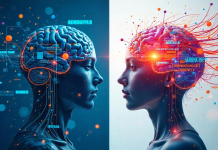
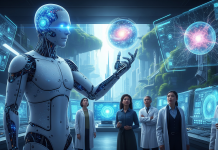
As we move deeper into 2025, technological innovation continues to accelerate at breakneck speed. From AI breakthroughs to quantum leaps in computing, the tech landscape is evolving faster than ever. Here are the top 10 tech trends that are shaping industries and everyday life in 2025.
Top 10 Tech Trends :
- Generative AI Goes Mainstream
- Quantum Computing Breakthroughs
- AI-Powered Cybersecurity
- Sustainable Tech and Green AI
- Spatial Computing and Mixed Reality
- Personalized Health Tech
- AI + IoT in Smart Cities
- Autonomous Everything
- Blockchain Beyond Crypto
- AI-Augmented Creativity and Media
1. Generative AI Goes Mainstream
Overview: Generative AI is no longer a niche tool. In 2025, it is embedded in marketing, software development, education, and more.
Data: According to McKinsey (2025), 79% of companies have adopted generative AI tools in at least one business function.
Example: GitHub Copilot and ChatGPT Enterprise help developers and content creators boost productivity by up to 40%.
2. Quantum Computing Breakthroughs
Overview: Quantum computers are moving from labs to real-world applications, particularly in finance, drug discovery, and logistics.
Data: IBM’s Quantum System Two (launched late 2024) supports over 400 qubits, marking a significant leap in computational capacity.
Example: JPMorgan Chase uses quantum computing simulations to optimize portfolios and manage financial risk scenarios.
3. AI-Powered Cybersecurity
Overview: With cyberattacks growing more sophisticated, AI is now used for real-time threat detection and autonomous response.
Data: Gartner predicts that by 2025, 60% of organizations will use AI-driven security operations centers (SOCs).
Example: Darktrace uses AI to identify and respond to threats faster than traditional systems, especially in zero-day attacks.
4. Sustainable Tech and Green AI
Overview: Environmental sustainability is a core focus. Tech companies are designing energy-efficient chips, algorithms, and cloud services.
Data: Google aims to operate on 100% carbon-free energy across all data centers by 2030 and is 66% there as of 2025.
Example: NVIDIA’s Grace CPU is designed to use significantly less energy than traditional server processors in AI workloads.
5. Spatial Computing and Mixed Reality
Overview: Mixed reality headsets and spatial computing are revolutionizing how people work, shop, and interact.
Data: IDC forecasts that the global mixed reality market will hit $23.8 billion in 2025, up from $15.1 billion in 2023.
Example: Apple Vision Pro and Meta Quest 3 are enabling spatial collaboration in industries like design, training, and healthcare.
6. Personalized Health Tech
Overview: Wearable devices and AI-powered diagnostics enable real-time, personalized health monitoring.
Data: The wearable health device market is projected to exceed $100 billion in 2025 (Statista).
Example: WHOOP and Fitbit track sleep, recovery, and cardiovascular health, while AI tools like SkinVision help detect skin anomalies.
7. AI + IoT in Smart Cities
Overview: The convergence of AI and IoT is making cities more responsive and efficient, with smart grids, traffic systems, and waste management.
Data: Over 50% of new smart city projects in 2025 are integrating AI for real-time decision-making (Frost & Sullivan).
Example: Singapore uses AI-driven surveillance and sensors to manage traffic, reduce congestion, and enhance public safety.
8. Autonomous Everything
Overview: From drones to delivery robots, automation is entering logistics, agriculture, and urban mobility.
Data: The global autonomous delivery market is expected to grow to $47.2 billion by 2025 (Allied Market Research).
Example: Amazon’s Scout delivery robot and Zipline’s autonomous drones deliver packages and medical supplies in urban and rural areas.
9. Blockchain Beyond Crypto
Overview: Blockchain is powering supply chain transparency, digital identity, and decentralized finance (DeFi).
Data: 65% of global enterprises are experimenting with blockchain in non-crypto use cases (Deloitte 2025).
Example: IBM Food Trust uses blockchain to trace food supply chains, improving safety and reducing fraud.
10. AI-Augmented Creativity and Media
Overview: AI tools are transforming the creative industries by co-generating music, art, video, and written content.
Data: By 2025, 30% of all creative content will involve generative AI collaboration (PwC).
Example: Adobe Firefly and Runway ML are being used by designers and filmmakers to speed up production and experiment with new formats.
Conclusion
Tech trends in 2025 are more than buzzwords—they’re transforming business, society, and personal lives at scale. Companies that embrace these innovations early will be better positioned for growth and resilience in an increasingly digital world.